


Every rating on your gear, in plain language.
Certification labels are only useful if you know what they certify. This guide decodes abrasion classes, armor levels, and coverage zones — so you can judge any riding garment, ours included.
Fabric protects skin. Armor protects joints and bones. AAA-class denim handles the slide; CE armor in the pockets handles the impact. A safe setup needs both — plus a helmet and proper boots.
AAA, AA, A — what the letters buy you.
EN 17092 is the European standard for motorcycle garments. Class is decided by laboratory abrasion, seam-strength, and tear tests — pass/fail physics, not marketing.
Survives the longest slide times in the standard's test rig — the class quality leather race gear certifies to. There is no lower tier in the Denimotto range.
Meaningful protection at reduced slide thresholds. Common in touring textiles where AAA weight isn't wanted.
The minimum garment class in the standard. Better than fashion denim — which certifies to nothing at all.
CE Level 1 vs Level 2.
| Spec | CE Level 1 | CE Level 2 |
|---|---|---|
| Impact absorption | Standard — transmits more force | Higher — transmits less force to the body |
| Best for | City & commuting | Highway & spirited riding |
| Bulk / flexibility | Slimmer, more flexible | Slightly thicker |
| Denimotto pockets fit | D3O, SAS-TEC, and standard CE inserts — hips + knees on jeans; shoulders, elbows, back on jackets | |
Some Denimotto pieces ship with CE Level 1 armor pre-installed; others ship armor-ready so you choose your level. Armor inclusion is stated on every product page.
Where riders actually slide.
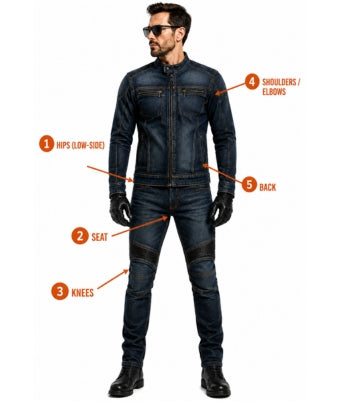
- 1
Hips — primary slide contact in a low-side. Aramid coverage + CE armor pocket on every pair of Denimotto jeans.
- 2
Seat — the longest fabric-to-road contact zone in most slides. Aramid-mapped on all builds; several extend seat-to-cuff.
- 3
Knees — impact and abrasion combined. CE armor pocket standard; fit type keeps the armor located over the joint.
- 4
Shoulders / elbows — jacket territory. CE armor at shoulders, elbows, and back on Denimotto jackets.
- 5
Back — add a CE back protector for highway riding. Vest and jacket builds accommodate inserts.
The five-point gear check.
-
[✓]
Helmet — certified, fitted, fastened. Non-negotiable, every ride.
-
[✓]
Abrasion layer — AAA-class garment covering hips, seat, knees. Fashion denim certifies to nothing.
-
[✓]
Armor seated — inserts in place and located over the joints, not drifted in the pocket.
-
[✓]
Boots — over-ankle, oil-resistant sole. Sneakers end badly.
-
[✓]
Gloves — hands hit first in almost every fall.
Treated right, a pair lasts 5–10 years.
Do
- Wash cold, inside-out, mild detergent
- Remove armor before every wash
- Air dry, out of direct sun
- Inspect seams and armor pockets seasonally
Never
- Bleach — destroys aramid fiber
- Fabric softener — coats and degrades the weave
- Tumble dry — heat damages the protective layer
- Ride gear that's been through a real crash — retire it
Quick answers.
What does EN 17092 AAA mean?
The highest abrasion class in the European motorcycle-garment standard — the garment survived the longest slide times in the lab's abrasion, seam, and tear tests. Every Denimotto piece certifies AAA, verified by independent ISO-17025 labs.
What's the difference between CE Level 1 and Level 2 armor?
Level 2 absorbs more impact energy — less force reaches your body. We recommend Level 2 for highway, Level 1 for city. Our pockets fit D3O, SAS-TEC, and standard CE inserts.
How long does Kevlar riding denim last?
5–10 years with correct care: cold wash, inside-out, armor out, air dry. No bleach, softener, or tumble drying.
Now you can read any gear label. Read ours.
Every product page states its class, coverage, and armor status — no decoding required.